The best BookFunnel alternative for reader magnets (an honest comparison)
· 10 min read
If you have decided to give away a reader magnet, the next question is which tool delivers it. Two names come up every time: BookFunnel and StoryOrigin. Both are good, both have been around for years, and for a lot of authors either one is the right answer. This guide compares them honestly, shows where Storyfinch fits, and, just as importantly, tells you when one of the others is the better choice.
We make Storyfinch, so treat this as a comparison with a point of view rather than a neutral review. We have tried to be fair about what the other tools do well, because pretending otherwise would not help you pick.
Why authors look for a BookFunnel alternative
People arrive at this question for a handful of reasons, and which one applies to you changes the answer. The most common are cost, especially the discovery that the cheapest BookFunnel plan does not collect email addresses; wanting a free tier to test the idea before committing; needing something simpler than a full suite; or wanting cleaner, exportable consent records. If none of those apply to you, staying put is a perfectly good decision.
What a reader magnet tool actually does
Strip away the extras and every tool here does the same core job: it gives your free book a signup page, collects the reader's email with their consent, delivers the file securely, and passes the subscriber to your mailing list. The differences are in what each tool adds around that core, and what it charges to do it.
Keep that in mind as you read, because some of these tools are large suites and you may be paying for a lot of features you will never touch.
BookFunnel
BookFunnel is the established name, and its reputation is deserved. It has spent roughly a decade doing one thing extremely well: getting ebook files onto readers' devices without the author fielding technical questions. Its device detection is excellent, and if a reader cannot work out how to load a book, BookFunnel's own help desk answers them rather than you. It also handles ARCs with locked, trackable review copies, delivers audiobooks, supports direct sales, and runs a large group-promotion network.
The trade-off is price, and one detail catches many new authors out. BookFunnel has no free plan, and its entry tier (First-Time Author, $30/year) does not let you collect email addresses at all, it only delivers files. To actually build a mailing list you need Mid-List Author at $200/year, and the top Bestseller tier is $300/year. Audiobook delivery is a paid add-on on top of those.
BookFunnel pricing explained
BookFunnel has three author plans, billed annually, with no free tier. The figures below are BookFunnel's own, checked in July 2026.
| Plan | Price | Collects emails? | Downloads | Notable limits |
|---|---|---|---|---|
| First-Time Author | $30/year | No | 500/month | Delivery only; no mailing-list capture |
| Mid-List Author | $200/year | Yes | 5,000/month | Up to 4 pen names; ARC delivery included |
| Bestseller | $300/year | Yes | Unlimited | Up to 6 pen names; priority support |
Audiobook delivery is charged separately on top, either usage-based or as a bundle (roughly $100 to $300/year depending on volume).
The detail that catches people out is the first row. The $30 plan looks like an affordable way in, but it does not capture email addresses, so it cannot build a mailing list. If list-building is the whole point of your reader magnet, your real entry price to BookFunnel is $200/year, not $30. For comparison, Storyfinch collects email addresses on its free plan and charges $29/year for Pro.
Choose BookFunnel if: you want the most polished delivery experience on the market, you deliver audiobooks or run serious ARC campaigns, or you value having a support team answer your readers' "how do I open this?" questions for you. It is a professional tool and it earns its price for authors who use its full range.
StoryOrigin
StoryOrigin is often called "the free alternative to BookFunnel," and it does have a free plan, but that label needs a caveat: the free Basic plan delivers files and does not collect reader email addresses. Its real draw is the community built into it: a newsletter swap and group-promotion marketplace where authors cross-promote each other's books to their mailing lists. For list growth without ad spend, that network is the main event, and it is strongest in busy genres like romance, fantasy and science fiction. StoryOrigin also handles ARCs and universal book links.
Collecting email addresses, along with swaps and group promos, needs the Standard plan at $10/month or $100/year. The honest caveat is that the swap network's value depends entirely on how active your genre is on the platform. In a busy genre it is powerful. In a quiet one, you are paying for a marketplace with few partners.
Choose StoryOrigin if: newsletter swaps and group promos are central to your growth plan, and you write in a genre with an active presence on the platform. That community is something neither BookFunnel nor Storyfinch tries to replicate.
Storyfinch
Storyfinch does the core job and deliberately not much more. You get a hosted signup page for every reader magnet, secure delivery through private links that expire, consent recorded and stored for every reader, and mailing list integrations. It does not have a swap marketplace, ARC review management, audiobook delivery or a direct-sales storefront. That focus is the point: it is the simple, compliant way to deliver a reader magnet, without a suite to learn.
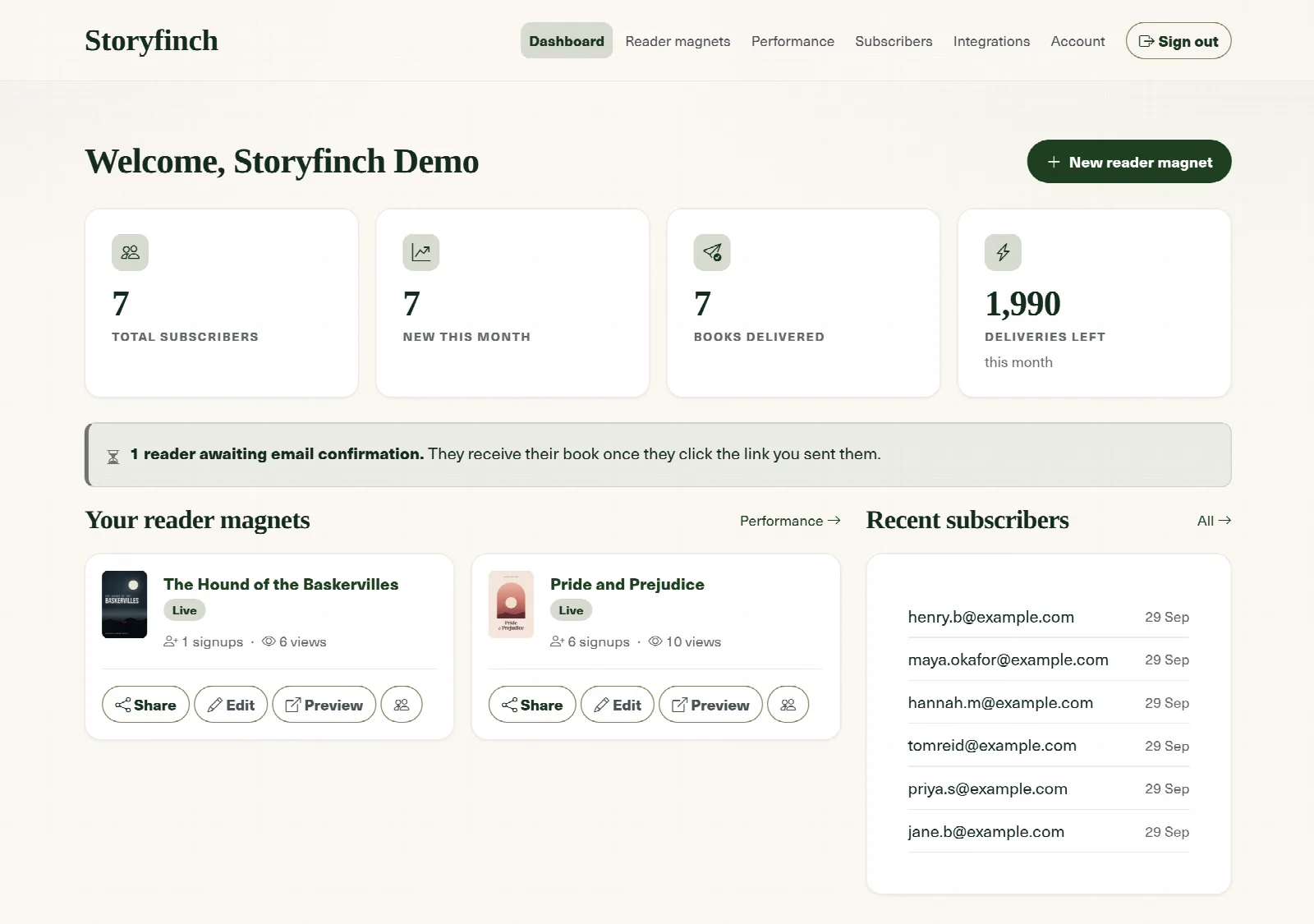
Two things make it stand out. First, price and email collection. Storyfinch collects email addresses on the free tier (1 active reader magnet, 50 deliveries a month). That is the one thing neither BookFunnel's $30 entry plan nor StoryOrigin's free Basic plan will do, which makes it the only free way of the three to actually build a list. When you outgrow the free tier, Pro is a flat $29/year for unlimited reader magnets, 2,000 deliveries a month, mailing list integrations and your branding removed, with no monthly bill and no per-integration add-ons.
Second, consent. Storyfinch records the exact wording each reader agreed to, and when, as an immutable record you can export. If you care about running a clean, provably-consented list, that is built in rather than bolted on.
Choose Storyfinch if: you want to collect emails and deliver a reader magnet as simply and cheaply as possible, you would rather not pay for swap marketplaces or ARC tools you will not use, and you want consent handled properly from your first reader. Look elsewhere if: you need audiobook delivery, ARC Certified Mail, a direct-sales storefront (BookFunnel), or a built-in swap and group-promo network (StoryOrigin). We do not do those, and we would rather tell you than waste your time.
At a glance
| BookFunnel | StoryOrigin | Storyfinch | |
|---|---|---|---|
| Free plan | No | Yes | Yes |
| Collect emails on the free/entry plan | No (needs $200/yr tier) | No (needs $100/yr tier) | Yes |
| Cheapest plan that collects emails | $200/year | $100/year | Free |
| Paid plan | $30 to $300/year | $100/year | $29/year flat |
| Secure, expiring delivery links | Yes | Yes | Yes |
| Consent records you can export | Limited | Limited | Yes, built in |
| Newsletter swaps / group promos | Group promos | Yes, its main strength | No |
| ARC / review copy management | Yes (Certified Mail) | Yes | No |
| Audiobook delivery | Yes (paid add-on) | No | No |
| Reader help desk | Yes | No | No |
Competitor prices and features were checked against BookFunnel's and StoryOrigin's own pricing pages in July 2026 and do change; check each provider's site for current details.
BookFunnel vs StoryOrigin vs Storyfinch, head to head
BookFunnel vs StoryOrigin. Both are broad suites. BookFunnel is the more polished deliverer, with better device handling and a support desk that answers your readers directly. StoryOrigin's pull is its swap and group-promo marketplace, and it reaches email collection far cheaper ($100/year against $200/year). If reader support matters most, BookFunnel; if cross-promotion or cost matters most, StoryOrigin.
BookFunnel vs Storyfinch. BookFunnel does considerably more: audiobooks, ARC Certified Mail, direct sales. Storyfinch does the core job (page, consent, secure delivery, list sync) on a free tier that collects emails, with Pro at a flat $29/year. If you use BookFunnel's wider feature set, it earns its price. If you only ever used it to hand out a reader magnet, you are paying for a lot you do not touch.
StoryOrigin vs Storyfinch. Closest on price, furthest apart in shape. StoryOrigin gives you a marketplace; Storyfinch gives you a focused delivery tool with consent records built in. Genre activity on StoryOrigin is the deciding factor: busy genre, real value; quiet genre, an empty marketplace.
So which should you choose?
If you are just starting out and mainly want to turn readers into subscribers without spending much, Storyfinch's free tier does the whole job, and $29/year covers you as you grow. If newsletter swaps are your growth engine and your genre is active, StoryOrigin's $100/year Standard plan is hard to beat. If you want the most polished delivery experience, audiobooks, or heavyweight ARC campaigns, BookFunnel is worth its price.
Plenty of authors also use more than one, for example running swaps on StoryOrigin while delivering their main reader magnet elsewhere. There is no rule that says you must pick only one. Our roundup of reader magnet delivery services also covers Prolific Works and doing it yourself.
Frequently asked questions
Is there a genuinely free way to deliver a reader magnet and collect emails?
Storyfinch is the only one of the three whose free plan collects email addresses. BookFunnel's $30 entry plan and StoryOrigin's free Basic plan both deliver files without capturing addresses, so neither builds a list until you pay ($200/year and $100/year respectively).
Can I move my reader magnet from BookFunnel or StoryOrigin to Storyfinch?
Yes. Your reader magnet is just your book file, your signup wording and your mailing list connection. You upload the file, set up a hosted signup page, connect your email platform, and update the link in your book back matter and profiles.
Does a cheaper tool mean less secure delivery?
No. Storyfinch delivers every book through a private link that is unique to each reader and expires, with an optional per-reader download limit, which is the same secure approach the larger tools use. See how to deliver an ebook.
How much does BookFunnel cost?
Three annual plans: First-Time Author at $30/year, Mid-List Author at $200/year and Bestseller at $300/year, with audiobook delivery charged separately. There is no free plan, and the $30 tier does not collect email addresses, so the cheapest plan that builds a mailing list is $200/year.
Is BookFunnel worth it?
If you deliver audiobooks, run ARC campaigns, sell direct, or want a support desk answering your readers' technical questions, yes. If you only use it to give away one reader magnet and collect emails, you are paying a mid-tier price for a fraction of the product.
What is the cheapest way to deliver a reader magnet?
Storyfinch's free plan, because it is the only free tier of the three that captures email addresses. After that the cheapest paid options are Storyfinch Pro at $29/year, StoryOrigin Standard at $100/year, and BookFunnel Mid-List at $200/year.
Do I have to choose just one tool?
No, and many authors do not. Running swaps on StoryOrigin while delivering your main reader magnet elsewhere is common, and nothing stops you keeping a BookFunnel account for audiobooks alone.
Grow your list with your next book
Give readers a free book and turn them into subscribers, with secure delivery and consent built in.
Create your free accountFree plan · No card required · Set up in minutes